Chalong
Temple
 Chalong
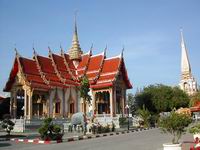
Temple (Wat Cha Long) is about 8 kilometers outside Phuket Town.
Take Vichit Songkram Rd. and turn left, and drive for about 10 minutes.
Chalong Temple will be on your left. This is where stands the cast
statue of Luang Por Cham, who helped the people of Phuket put down
the Ahngyee, or Chinese Coolie, Rebellion in 1876 during the reign
of Rama V. There are also statues of Luang Poh Chaung, and Luang
Poh Gluam, other monks, who were abbots of the temple during later
times, and who are the object of respect and recipients of offerings
by Phuket people generally. Chalong
Temple (Wat Cha Long) is about 8 kilometers outside Phuket Town.
Take Vichit Songkram Rd. and turn left, and drive for about 10 minutes.
Chalong Temple will be on your left. This is where stands the cast
statue of Luang Por Cham, who helped the people of Phuket put down
the Ahngyee, or Chinese Coolie, Rebellion in 1876 during the reign
of Rama V. There are also statues of Luang Poh Chaung, and Luang
Poh Gluam, other monks, who were abbots of the temple during later
times, and who are the object of respect and recipients of offerings
by Phuket people generally.
Back to TOP
Pra
Tong Temple
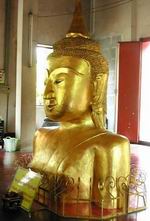 This
shrine encloses a golden statue of Buddha that sprang up from beneath
the earth long ago. The story is of a young boy who tied his buffalo
to what he thought was a post; it was in an area at that time given
over to the raising of animals. After doing so, he fell down in
agony and died. The father of the boy dreamed that the reason his
son had died was for the sin of tying a filthy buffalo to a sacred
object, that what the boy thought was a post was in reality the
golden peak of the Buddha's conical cap. He told his neighbors the
dream and they all went out to dig up the statue but had no success. This
shrine encloses a golden statue of Buddha that sprang up from beneath
the earth long ago. The story is of a young boy who tied his buffalo
to what he thought was a post; it was in an area at that time given
over to the raising of animals. After doing so, he fell down in
agony and died. The father of the boy dreamed that the reason his
son had died was for the sin of tying a filthy buffalo to a sacred
object, that what the boy thought was a post was in reality the
golden peak of the Buddha's conical cap. He told his neighbors the
dream and they all went out to dig up the statue but had no success.
Later, at the time of Thao Thep Kasatri's heroic defense against
the Burmese in 1785, the invaders tried to succeed where the villagers
had failed; their intention was to take the statue back to Burma.
Sacred objects and slaves were then the most sought after spoil
for armies: Holy statues brought good luck to their possessors,
and the slaves were used for work, and to populate places that lacked
inhabitants - a frequent problem four rulers in Southeast Asia,
who had a great deal of land but very few subjects. The Burmese,
hewer, were unable to retrieve the golden Buddha despite several
attempts; they were finally driven off by a swarm of angry hornets.
After this the villagers decided to protect their miraculous statue
by covering the part that stuck up from the ground with a plaster
cast of Buddha's head and shoulders which is the way it is today.
Located north of the traffic light on the outskirts of Thalang Town.
A large sigh shows the entrance.
Back to TOP
Pra
Nahng Sahng Temple
The grounds of this historic temple are where
the Battle of Thalang took place in 1785. Inside are there very
old statues wrought in tin of the Buddha; they are the largest such
in the world and date from a time when tin was regarded as a semi-precious
metal. The bellies of the three big statues each contain a smaller
statue, from which derives their name, 'Monks in the Belly' in local
vernacular, or 'The Three king' in formal language. Located on Thep
Krasatri Rd. in Thalang Town at the traffic light.
Back to TOP
Chinese Shirnes
There are so many Chinese Shirnes in Phuket.
Some of the interesting shirnes to visit include:
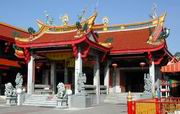 Chui
Tui Shirne (Saan Chao Chui Tui): Chui Tui Shirne is one of the
most popular shirne in Phuket. During Vegetarian Festival, visitors
can find a lot of vegetarian food along Ranong Rd., and in front
of the shirne. The shirne is located on Soi Phuthon, Ranong Rd. Chui
Tui Shirne (Saan Chao Chui Tui): Chui Tui Shirne is one of the
most popular shirne in Phuket. During Vegetarian Festival, visitors
can find a lot of vegetarian food along Ranong Rd., and in front
of the shirne. The shirne is located on Soi Phuthon, Ranong Rd.
Thep Rasi Shirne or Bang Niao Shirne (Saan Chao Thep Ra Si
or Saan Chao Bang Niao): The shirne was built in Chinese style,
located on Phuket Rd., the way to Sapan Hin.
Back to TOP
|

PHUKET Province
• Attractions
• Activities
• Festivals
• Hotels
• Local Food
• Restaurants
• Shopping
• Tours
• Getting There
• Getting Around
• General Info
• History
|





 HOME
HOME


